



 13 / 52

Feb 2016
11
media reports, drawn from 1961
to 2014. That work revealed that
poisoning from eating pesticide-
laced carcasses caused as many
as 60 percent of the vulture
deaths recorded since the 1970s.
Poisoning takes two forms:
- Indiscriminate poisoning of
vultures – a by-product of
people trying to deliberately
eradicate mammalian
predators of livestock (and in
some areas feral dogs), with
the poisoned carcasses or
baits inadvertently attracting
vultures.
- Poachers deliberately
targeting the birds to avoid
them giving away the
presence of their illegally
killed big game carcases,
such as rhinos or elephants.
Between July 2011 and 2014,
at least ten such poisoning
incidents were discovered,
which resulted in the deaths
of at least 1,500 vultures
across six southern African
countries.
• The use of vulture body parts in
traditional medicine – a recent
scientific paper found that 29%
of the vulture deaths recorded
continent-wide could be
attributed to this secretive trade.
These practices are thought to
be widespread in West Africa,
as well as Southern Africa. Body
parts of vultures are used by the
traditional medicine industry for
a number of purposes.
Other factors thought to play a role
in the declines include habitat loss,
human disturbance and collisions with
wind turbines and electricity power
lines (as well as electrocution by the
latter).
v
In a personal post Darcy Ogada, assistant director of Africa Programs for the
Peregrine Fund writes in Explorers Journal on 30 June 2015:
Among members of the public, I describe myself as a conservationist, or more
typically my response is, “I study birds.” Among my conservation colleagues,
I have to go a step further – ”I study vultures” – to which the near-unanimous
reply is “I just don’t see vultures anymore.” Sigh …
Sadly, that statement reflects the reality on the ground these days across Africa.
In particular, the past five years have been brutal for what are arguably nature’s
most important scavengers.
Poisoning, poisoning, and more poisoning. Whether you’re a fan of vultures’
unique lifestyle or not, you can’t begrudge an animal a safe meal when that
animal does such ubiquitous good for mankind. Yet for a vulture, to eat and be
poisoned or not to eat: that is the question.
Sixty-six vultures were poisoned in one incident at Derby farm, Limpopo,
South Africa on May 7, 2015. Poisoning is the biggest threat to Africa’s vultures.
Majestic to those who know them, yet unloved by many, vultures bear the
brunt of retaliatory poisonings targeting predators that have killed livestock.
The poaching crisis facing elephants has also quietly resulted in the carnage of
thousands of vultures. Over the last three years poachers have relentlessly laced
elephant carcasses to eliminate vultures and prevent their overhead circling from
giving away the scene of the crime.
Then there is the unsustainable harvesting of vultures for traditional medicine.
How “traditional” (or medicinal?) is your vulture-based medicine when
40 percent of parts on sale come from birds that have been killed by pesticides?
That Africa’s vultures are in crisis is no longer in doubt. Our most recent study
confirms that eight species of African vulture have declined an average of
62 percent over the past three decades. Given annual decline rates, they are
projected to decline from 70-97 percent over three generations, or approximately
50 years. Without conservation intervention, extinction is certain. And because
vultures don’t breed like rabbits, their declines will be felt for many decades to
come.
For those of us working to conserve Africa’s vultures, we are a beleaguered
bunch. Vultures in the wild desperately need our help to raise awareness about
the need for better regulation of pesticides and other poisons, particularly in
Africa. To find out how you can help, log in to
www.peregrinefund.orgArticle
I Artikel
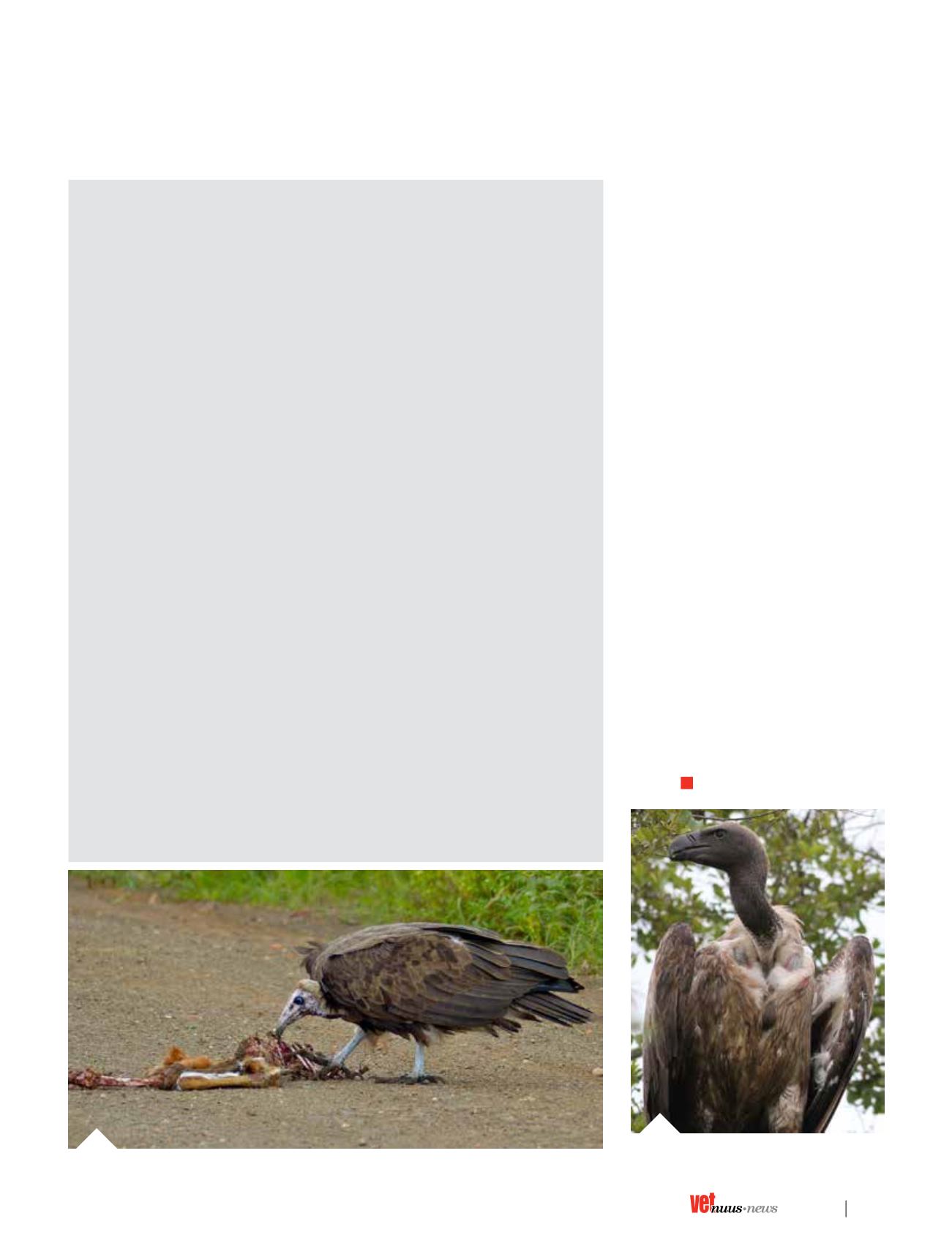
Hooded vulture (photograph by Bernard Dupont, via Wikimedia Commons)
Cape vulture (photograph by Derek Keats,
via Wikimedia Commons)