


 19 / 52

Feb 2016
17
Article
I Artikel
have played a key role in the
development and implementation of
the RhODIS Kit for sample collection.
The South African Department of
Environmental Affairs introduced
amendments to the norms and
standards for sample collection
and identification of live and
poached rhinos under the National
Environmental Management:
Biodiversity Act 10 of 2004 which
requires that samples are collected
from all poached rhinos and other
rhinos that are immobilized or die
using RhODIS
®
kits which then
have to be submitted to the VGL for
inclusion on the RhODIS
®
database.
A number of other bodies including
the South African National Parks
Honorary Rangers, the World Wildlife
Fund, corporates and individuals
have donated funds to support the
development and implementation of
RhODIS
®
.
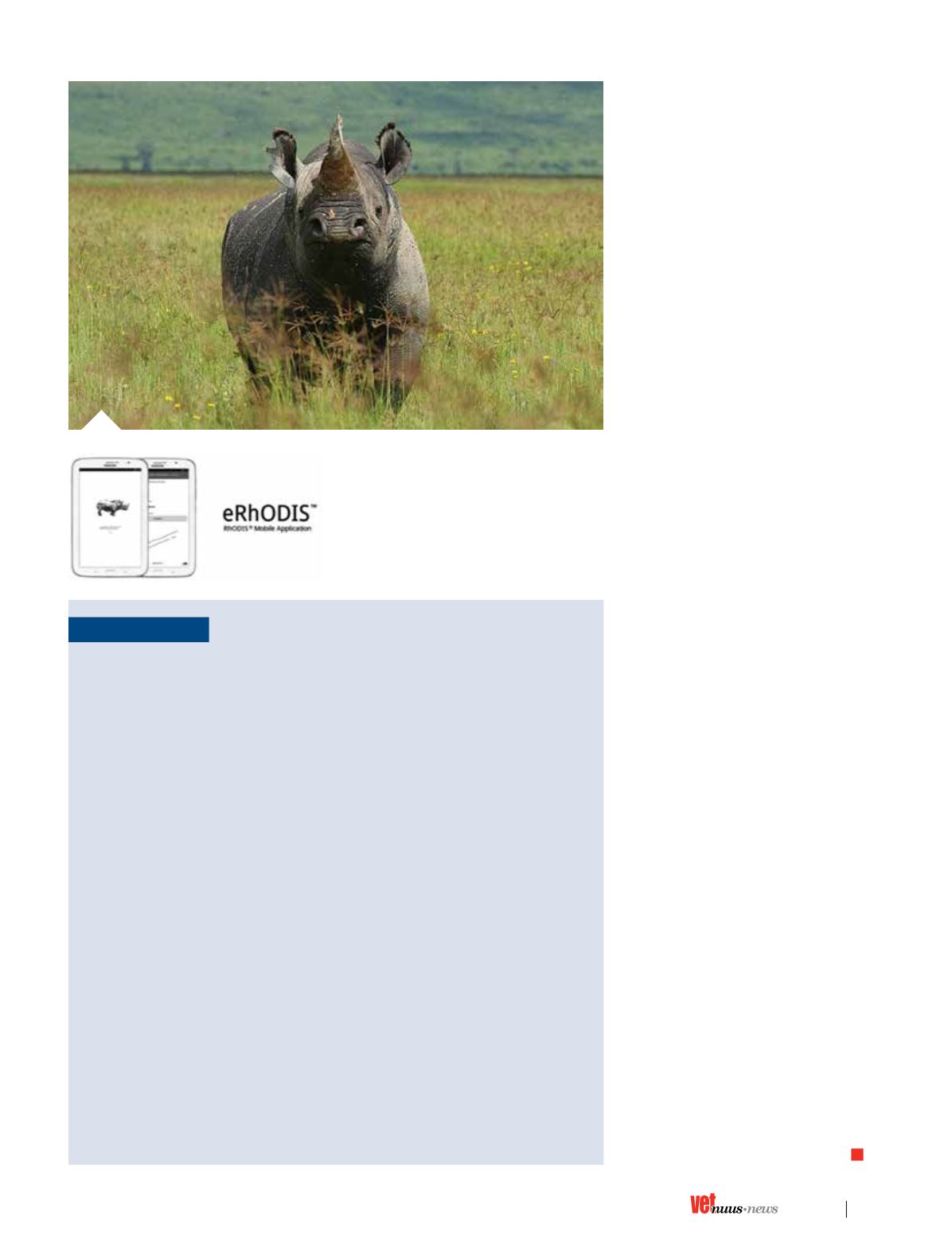
eRhODIS
TM
, a mobile application
(app), has been developed as an
adjunct for RhODIS
®
to aid in the
collection of samples and information
relevant to the RhODIS
®
project.
The app is used to gather DNA
evidence, geographical data and
upload photographs. In addition to
the forensic uses of the app, it is also
used to collect information of live
rhinoceros and horn in stockpiles,
which further provides a powerful
tool for authorities to trace and link
each animal and horn individually.
The archive presently includes over
15 000 samples from black and white
rhinoceros from all over Africa.
The eRhODIS™ app has been
designed to guide the user through
the standard procedure of collecting
samples and completing required
data fields. During a rhino poaching
investigation, data is initially collected
at the crime scene. Equipped with
a Samsung tablet loaded with the
application, investigators are able
to collect data related to the DNA
evidence and upload information to
a secure cloud server as soon as the
device is within network range.
The laboratory receives this
information instantly and is able to
view who submitted the report. A
completed sample collection form,
in PDF format, is emailed to the
investigator which is then printed
and added as a paper copy to the
evidence bag with samples for
submission to the laboratory.
Our congratulations to the team!
v
THE ENTRY
INTERNATIONALISATION OF RHODIS
®
AND
ERHODIS
TM
AS BENCHMARK FORENSIC TOOLS TO
COMBAT WILDLIFE CRIME
University of Pretoria, South Africa
Science and Tech Type: DNA Analysis or Databases
The DNA- and IT-based Rhino DNA Indexing System (RhODIS
®
) and
Electronic Rhino DNA Indexing System (eRhODIS
TM
) provide forensic tracing
for African rhinoceroses and their parts (including horns), linking parts back
to source animals and criminals to specific crimes. The project aims to
increase its impact through development and validation of an internationally
available rhinoceros nuclear DNA analysis kit.
The Problem:
although adopted by all the African Rhinoceros Range States,
RhODIS
®
has received samples from less than 50 percent of media-reported
horn seizures. DNA samples collected are frequently of varying quality, held
up by red tape, or face chain-of-custody issues. An international system
that standardizes DNA and data-collection processes and facilitates delivery
to forensic testing labs may help authorities’ better monitor illegal trade
involving rhinos.
The Team:
RhODIS is led by the University of Pretoria’s Veterinary
Genetics Laboratory. The team includes a chief analyst, six technicians, two
administrative staff members, a systems developer, and a quality manager.
Solution Partners:
The South African National Parks, which provided initial
project funding, and the South African Police Service.