


 23 / 52

Feb 2016
21
Early separation of cow and calf has long-term
effects on social behaviour
I
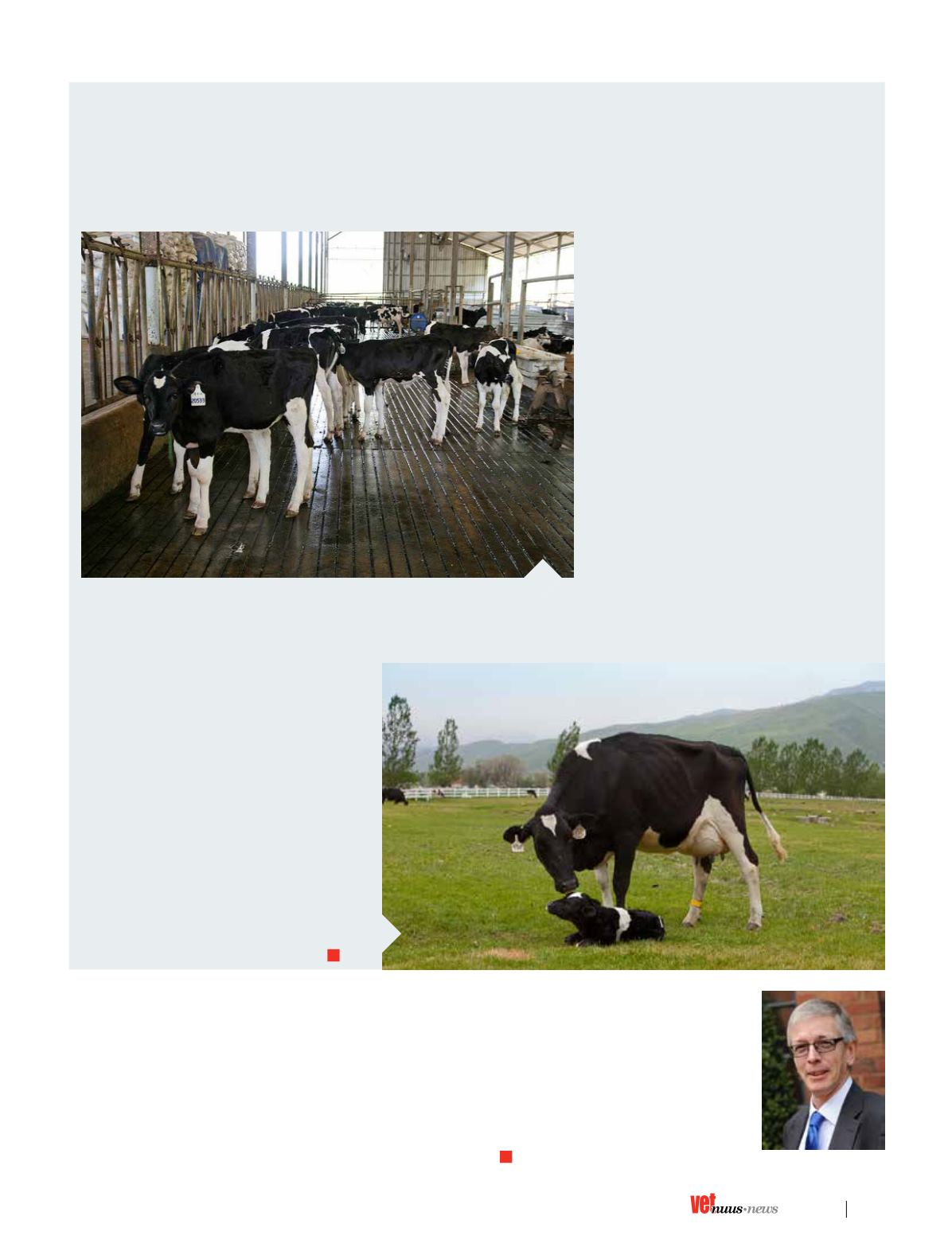
n a recent study, researchers from the Vetmeduni Vienna examined a total of 26 differently reared cows. Eleven animals
were separated from their dams immediately after birth before entering the calf group and being fed milk via automatic
feeder. The remaining 15 calves were kept with their dams in the calving pen for the first five days and were able to
establish a dam-calf bond during this time.
These calves were then also moved to the
calf area, but continued to have contact
to their dams. Nine of these calves were
allowed access to their dams twice a day,
while the remaining six were able to move
between the calf group and the cow herd
at all times.
The scientists performed different tests
with the grown-up animals to determine
whether the different rearing strategies had
a long-term effect on the behaviour of the
animals in stress situations.
Cattle which grew up with their dams
expressed the highest levels of cortisol
during isolation, but the heart rate (another
way of expressing stress) measured in
these animals was the lowest. This could
possibly indicate that the different rearing
treatments result in different reaction types to stress.
Differences could also be seen in the animals' behaviour. Calves reared with their dams, especially those who had constant
maternal contact as well as contact to the herd, were more active during isolation: they moved more in their calving boxes
and explored their surroundings more
actively than cattle reared without their
dams. This could indicate a higher level of
motivation to re-join the herd and a more
active way to cope with the challenge of
isolation.
The research shows that a richer social
environment during rearing, i.e. with
contact to dams and to other cows,
makes animals more sociable and socially
competent as adults. We must increasingly
consider whether a socially restricted early
environment represents the ideal form of
animal husbandry.
(Source:
www.sciencedaily.com/releases/2015/04/150428081801.htm)
v
Briefly
I Kortliks
A
ntibiotics
and
antibiotic
resistance
<<< 20
resources on the WSAVA's website and are gradually driving a change in vaccination practice
throughout the world - a change which is set to have a major impact on day-to-day small animal
practice."
"We are delighted to launch these updated versions both for veterinarians and for pet owners and
breeders. We hope they will prove even more helpful and ensure that more small animals are
vaccinated in a more scientifically-based, robust and safer fashion."
"We would like to thank MSD Animal Health which has been the sole sponsor of the VGG since its
inception. Its support enables us to undertake our valuable work."
v
Prof Michael Day