



 21 / 52

Feb 2016
19
Ancient giants reveal the realities of climate change
W
hen a giant baobab toppled over in the Pafuri area in the northern-most part of the Kruger National Park a
number of years ago, researchers from the University of Pretoria (UP) had a hunch that the fallen giant could give
them access to a wealth of information about the past. The team seized the opportunity and travelled to Kruger
to collect samples. The hunch turned into a research project that has now evolved into an international collaborative study
that covers Southern Africa and Madagascar.
The objective of the study is to determine the effects of climate change over the whole of southern Africa over the past
1 000 years by using trees to reconstruct rainfall patterns. The researchers are in the process of producing a mega-map of
rainfall and drought and the study is providing valuable insight into both the natural and anthropogenic effects of climate
change.
The study aims to determine the extent of change in areas with varying rainfall. Baobab trees, which are found
predominantly in summer rainfall areas, are excellent study models as they can live for more than 1 000 years. In winter
rainfall areas, the study looks at trees such as the yellow wood, while camel-thorn trees provide similar information about
desert areas.
Information is retrieved
from these trees by
applying a method
known as coring, which
does not require the
trees to be cut down.
Coring involves the
study of tree rings
to determine the
age and growth rate
of a tree. Samples
are taken to the UP
Mammal Research
Institute’s isotope
laboratory where
isotopic analysis of the
samples’ properties
and the age of the
tree is undertaken to
reconstruct rainfall
patterns. The chemistry
of the wood reflects
the growing conditions
and the periods during
which growth occurred
(rainfall periods), as
well as the periods during which the trees were under water stress (drought periods). As a tree grows, new rings are
formed on the outside of trunks or branches year after year, and the chemistry of each ring gives insight in the climate
changes in the area where the tree is located.
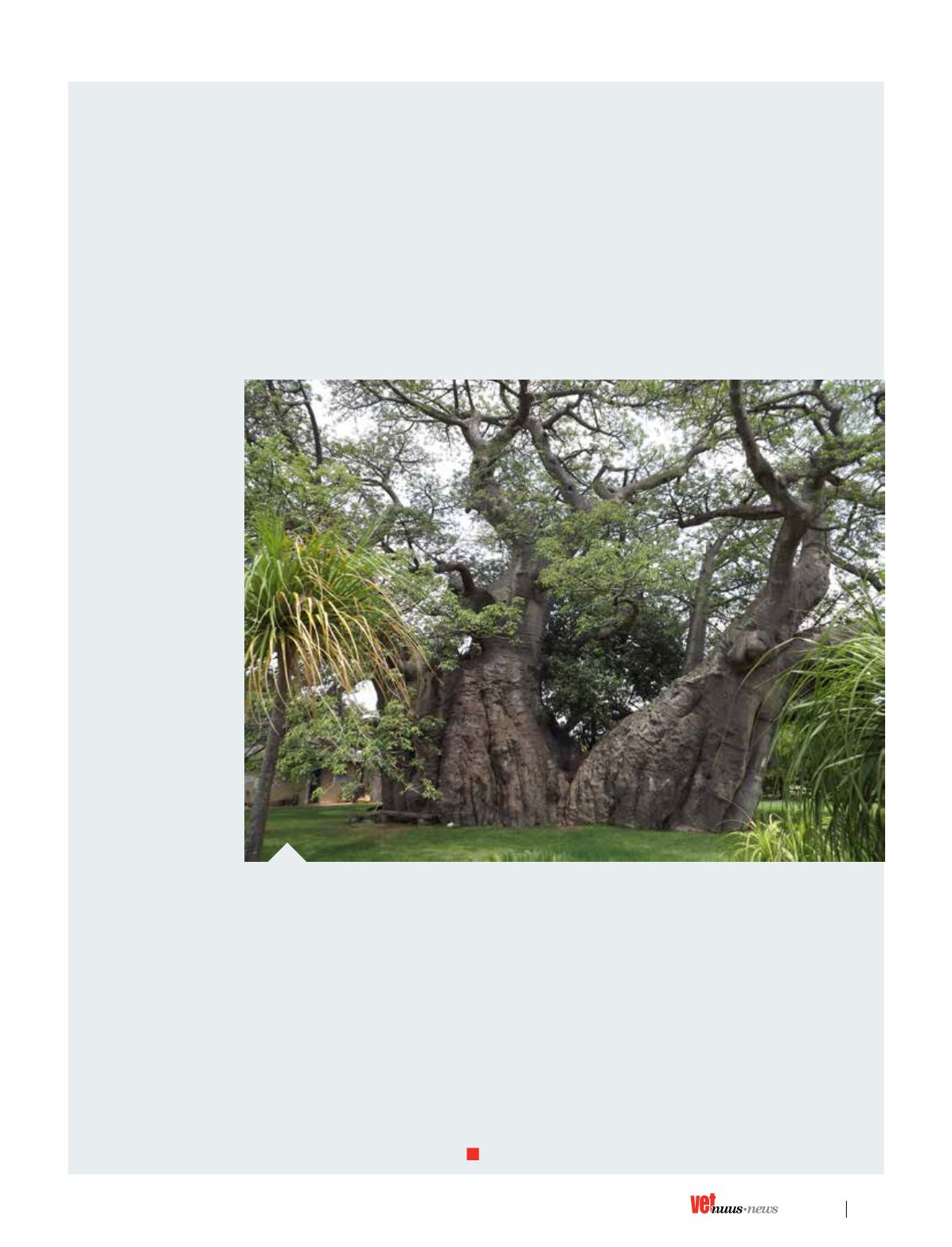
The study has also allowed researchers to develop an age model for baobabs. Giant baobabs are often mistakenly believed
to be just one big tree, while in fact they often consist of multiple trunks that have fused together. This explains why only
some trees have hollows in their trunks.
The study has also provided insight in how communities have adapted culturally in response to the significant climate
changes that have occurred over the years. Areas such as the Limpopo valley, where livestock farming and agriculture
once thrived, are now desolate as they have become too dry for such activities.
Information gained from the different baobab sites to date confirms the major climate shifts in southern Africa with, for
example, the expansion of the Kalahari eastward to areas that were once characteristically summer rainfall areas. The study
of the giant baobabs has put an end to the debate on whether climate change is real or not and has confirmed the very
serious effects of climate change and greenhouse gases.
(From an article by Louise de Bruin, University of Pretoria)
v
Briefly
I Kortliks